Showing posts with label James Franco. Show all posts

Tuesday, April 19, 2016

James "I'm a gay cock tease" Franco


http://www.huffingtonpost.com/entry/james-franco-gay_us_57154224e4b0060ccda4075b

James Franco: ‘I’m A Little Gay’
When it comes to his sexuality, the actor-provocateur is as coy as ever.

04/19/2016

“Yeah, I’m a little gay, and there’s a gay James,” he said. 


James Franco’s affinity for gay-themed film projects have prompted widespread speculation about his sexuality for years. Now, however, the acclaimed actor-director is coming out. Sort of.

In a candid interview with New York magazine, Franco, 37, criticized what he described as the media’s “overfocusing” on his sexuality after he explored gay themes onscreen in “Milk,” “I Am Michael” and behind the camera in “Interior. Leather Bar.”

Noting that his celebrity status alone created interest in “who I’m having sex with,” Franco said, “If your definition of gay and straight is who I sleep with, then I guess you could say I’m a gay cock tease. It’s where my allegiance lies, where my sensibilities lie, how I define myself.”

He then cryptically concluded, “Yeah, I’m a little gay, and there’s a gay James.”

Franco seemed to be echoing sentiments he shared in a 2015 issue of FourTwoNine magazine that featured an article in which he interviewed himself as “Straight James Franco” talking to “Gay James Franco.”

“I like to think that I’m gay in my art and straight in my life. Although, I’m also gay in my life up to the point of intercourse, and then you could say I’m straight,” he said. “I am a figure who can show the straight community that many of their definitions are outdated and boring. And I can also show the gay community that many of the things about themselves that they are giving up to join the straight community are actually valuable and beautiful.”

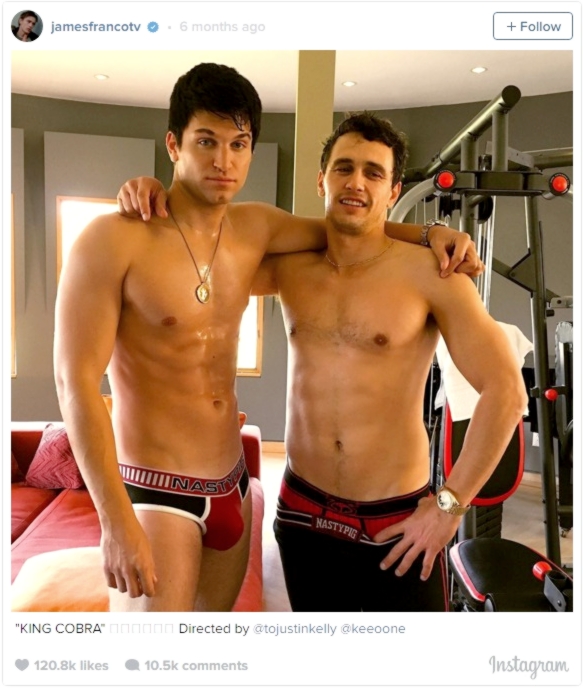
Franco’s latest project seems likely to only fuel that speculation further. “King Cobra,” which also stars Garrett Clayton, Molly Ringwald and Christian Slater, is based on the 2007 murder of gay adult film impresario Bryan Kocis. Franco’s production company, Event Films, is behind the film, which premiered this month at the 2016 Tribeca Film Festival.

True to form, Franco teased fans with a sweaty, shirtless Instagram photo of himself posing with co-star Keegan Allen on the set in October.


As easy as it is dismiss Franco’s professed interest in gay themes as another case of Hollywood “queer baiting,” “King Cobra” is already generating positive buzz around its Tribeca release. So it’s safe to say we’ll see him exploring more same-sex love on the big screen in years to come.


Sunday, January 24, 2016

James Franco to Star in '70s Adult Film Drama, 'The Deuce'


James Franco will play the role of mob twins Vincent and Frankie Martino.

BY XAVIER PIEDRA
FRI, 2016-01-22


HBO has ordered a new series that will take place in Times Square during the rise of the porn industry during the 70s. From the creators of The Wire, the upcoming HBO drama The Deuce will star James Franco as mobster twins Vincent and Frankie Martino— forerunners of the sex industry.
The title of The Deuce was street slang for the block of 42nd street between Seventh and Eighth Avenues before it was cleaned up by the late 90s. The series will follow the legalization of the porn industry before the rise of HIV and the cocaine epidemic that ended the era.
Franco will also star alongside Broadway star and actress Maggie Gyllenhaal. Gyllenhaal will be playing the role of Candy, a prostitute who works her way into the porn industry.

No official airdate has been released, but it's a safe bet that Franco will probably be naked.

Saturday, July 18, 2015

Gawker Is Full of Shit


GROSS

07.17.159:50 PM ET

Gawker’s Homophobic, Years-Long Crusade to Out James Franco

Gawker has come under fire for unscrupulously outing a Conde Nast exec—and arguably abetting a blackmail plot. But they’ve been similarly harassing James Franco for years.


On Thursday evening, the media website Gawker ran a clickbait “scoop” about an executive at a major magazine company who had enlisted the services of a gay porn star/escort, arranging to pay him $2,500 for a weekend tryst. The john was married to a woman with two young children, and his brother once served as a senior official within the Obama administration.
Once the prostitute caught wind of the john’s powerful ties, he proceeded to blackmail the CFO by threatening to expose the arrangement unless he helped the escort with a housing discrimination case against a former landlord—one that he’d allegedly brought to the attention of his local politician, presidential candidate Ted Cruz (R-TX). Gawker, as is its wont, published all the text messages between the two—effectively outing and shaming the exec—while protecting the identity of the blackmailer, who turned out to be a complete nutjob.
The media then began (rightfully) policing Gawker for the despicable post, which only seemed to embolden its editor-in-chief, Max Read, who tweeted out a defense of the piece:
The problems with the story, as laid out astutely by The Intercept’s Glenn Greenwald, were that the man was not a public official, the post did not serve the public interest, and that Gawker may have even abetted a blackmail plot by serving as a bargaining chip. The post was taken down Friday evening at the behest of Gawker’s management board, and Gawker founder Nick Denton later released a mea culpa, claiming he’s experienced what alcoholics refer to as a “moment of clarity.”
Perhaps the vilest thing about the piece is how laced with homophobia it was, as its main, hateful “mission” seemed to be outing a man, as if being gay was something to be ashamed of in 2015, mere weeks after the Supreme Court legalized same-sex marriage in all fifty states.
But Gawker Media has long harbored a creepy obsession with outing closeted men. Back in 2007, one of its first controversial stories involved its sister site Valleywag publishing a piece outing Silicon Valley venture capitalist Peter Thiel in a post titled, “Peter Thiel is totally gay, people.” In the comment section of the piece, Denton wrote that he was confused why Thiel would keep “his personal life a secret from journalists…” as if he was entitled to this information from a non-public figure. And then there was the unfortunate outing of Fox News anchor Shepard Smith in 2013, a nasty gay fright piece that was eviscerated in a columnby the late, great New York Times media critic David Carr.
But no one has been on the receiving end of more harassment by Gawker than Oscar-nominated actor James Franco.
“Yeah, and then they got a little pissy because I said it was ‘homophobic,’ and yeah it is,” said Franco. 
The repugnant hit pieces began around 2008, as Franco was mid-transition from wandering himbo to serious actor, with standout performances in the stoner comedy Pineapple Express and as the gay lover to Sean Penn’s Harvey Milk in Milk. Historically, there has been a troubling tendency by the movie-going public and tabloid media to question an actor’s sexuality once he’s convincingly played a gay character onscreen. Gawker, however, took it one step further: they accused Franco of being a gay rapist.
On August 18, 2008, the New York Post ran a gossip blind item that read: “Which hunk in a summer movie is a violent, closeted homosexual? The heartthrob snuck into his ex's apartment a few months ago and raped him so violently, the ex ended up in the hospital - and the actor paid him $500,000 to keep his mouth shut.”
Back before Denton’s “change of heart," Gawker had a tendency to blindly speculate about gossip blind items—which, for all we know, could be completely made up. But they took particular interest in this one, with then-Gawker writer Richard Lawson penning a follow-up post guessing that the gay rapist might be either Will Smith, Christian Bale, or James Franco, based purely (or rather, impurely) on Internet rumors.
“And then there's the compelling case of James Franco,” Lawson wrote. “Basically the rumor is that Franco dated the guy about two years ago, and still had a key to his house. Guy goes to an Oscars party, comes back and Franco is waiting for him and then awfulness goes down. He's rumored to have been abusive towards an old girlfriend, also an actor, some five years ago. This makes me sad because James Franco is dreamy and oh if he were gay we'd surely be married next spring, but if he's a raper then I don't want anything to do with him and he should be in jail.”
Days later, Lawson penned a follow-up post titled:


Gawker
All it did was tally up commenters’ feelings, who voted that among the three baseless candidates, Franco was their choice as likeliest perp. Again, this is all a guessing game, and all of these pieces still live online. The following month, Lawson wrote another Gawker post titled:


Gawker
The piece was pegged to Franco’s role as Penn’s character’s gay lover in Milk—and a subsequent interview with Out magazine—and, based on no evidence whatsoever, the Gawker article insinuated that Franco was a gay rapist, mentioning “the ominous rumor that he once raped his gay lover.” It also questioned Franco’s sexuality based on his playing two gay roles in films.
Lawson, who penned all of the aforementioned Franco posts, took to Twitter last night to admit that his posts accusing Franco of being a gay rapist were “baseless” and that he wrote them on the orders of his “boss” (he’s since deleted the tweet), essentially admitting that he’d based them on unsubstantiated claims:


Twitter
In a statement to The Daily Beast, Lawson said, “I deeply regret those posts. Though they don't really have any upside, maybe they can at least serve as a warning for younger writers now to use far better judgment than I did back then.” Franco could not be reached for comment.
Things were left dormant until, in 2013, Gawker’s then-staff writer (and now editor-in-chief) Max Read wrote a post with the headline, “James Franco Is Gay,” and embedded an Instagram post Franco issued of him and a man gallivanting about New York City and kissing with the tongue-in-cheek caption, “#JamesFrancoTV in love????? #gawker.com #gay.” This was clearly Franco trolling Gawker, yet they ran a definitive clickbait-y headline proclaiming him gay, without including so much as a question mark.
Franco was, presumably, responding to the years of harassment he’d received about his sexuality by Gawker, including a recent post by writer Rich Juzwiak two weeks earlier following his Comedy Central Celebrity Roast titled, “James Franco’s Friends and Roasters Agree That He Is Very, Very Gay.” And Juzwiak, who months later would pen a post with the clickbait headline, “James Franco Bares Ass to Gay Men”—which solely consisted of Franco flashing his behind for charity at a Broadway Bares event that ended up raising $1.3 million for the fight against AIDS—would later whine about being disinvited from a Franco afterparty.
Gawker escalated their Franco witch-hunt with a post on August 6, 2014, that read, “James Franco Is Living With a Man.” The post, penned by J.K. Trotter, suggested that Franco was in a gay relationship with his frequent co-star Scott Haze solely based on a line in a recent New York Times profile of Franco where the Oscar-nominated actor shared that he and Haze lived in the same place. 
Franco responded to the Gawker item—which still lives online—with posts on his Instagram and Facebook pages accusing Gawker of “always getting the cutting edge, homophobic scoop!” 
The following day, Trotter doubled-down on his baseless Franco “outing” with a post titled, “A Short History of James Franco and Scott Haze Playing Gay,” which once again insinuated that Franco was in a gay relationship with Haze based merely on the closeness of their relationship—the fact that they’d been friends for a decade, and spent a lot of time together. This post also still lives online.
About a month after the two accusatory Gawker posts, I sat down with Franco and Haze at the Venice Film Festival, where they were on hand to promote their film adaptation of the Faulkner classic The Sound and the Fury. During our interview, I asked them about the Gawker posts alleging that they were a gay couple.

“Oh god,” replied Haze, shifting in his seat and showing signs of frustration.
“Yeah, and then they got a little pissy because I said it was ‘homophobic,’ and yeah it is,” added Franco. “And then they said, ‘Oh, well a gay guy wrote it!’ I don’t care if the press is gay or straight. When did you have to face criticism for having a roommate? I don’t understand that!”
He paused. “And there were like… eight people living in that house, so to make a story about that—I don’t care, but it just shows how petty Gawker is. It’s ridiculous.”
Towards the end of our interview, I jokingly asked them when they were going to “hook up” on a new project again in the future, and they both started cracking up.
“Hey, no comment!” said Haze, bowled over in his seat. Franco patted him on the back and, barely containing his laughter, added, “Here in Venice? Pretty damn romantic!”
At least he hasn’t lost his sense of humor about it, though it stands to reason that given Gawker’s constant stream of harassment, Franco has a pretty strong case against them.


# # #


FOOTNOTE: READ ON . . .

http://www.thedailybeast.com/articles/2015/07/17/gawker-got-in-bed-with-the-wrong-escort-and-civil-war-ensues.html


Wednesday, March 18, 2015

Straight James Franco, Gay James Franco


The straight James Franco talks to the gay James Franco


With three films slated for this spring — True Story, I Am Michael, and Wim Wenders's Everything Will Be Fine — James Franco continues to be the busiest man in show business. Actor, director, producer, writer, poet, professor, social media maven, and cultural provocateur, he also continues to challenge us by challenging himself about preconceived concepts of sexuality and how they fit contextually into his art. So it was no surprise when he accepted this challenge to sit down with himself to discuss his life together.

By James Franco


Straight James: Hey, bud, this is weird. You’re interviewing yourself.
Gay James: Yeah, I know. Who’s doing the interview, and who’s being interviewed?
SJ: Let’s just have a convo, and we’ll both try to get to the bottom of James.
GJ: Okay, deal. But my question is, who is the real James, and who is the mask?
SJ: I guess that’s what everyone wants to know, right?
GJ: I guess, but I also guess that even though I have this public persona that is all wacked out and hard to pin down, or annoying, or whatever, in some ways I’m still more real than if I were just hiding behind a façade or whatever.
SJ: Façade. Meaning, like, a movie-star façade?
GJ: Yeah, like I just hide behind my movies, and try to look cool, and don’t talk about anything of substance, and just give bland answers to everything like an athlete. “Yeah, we played with heart out there tonight. Really brought it.”
SJ: OK, so, good place to start. Let’s get substantial: are you fucking gay or what?
GJ: Well, I like to think that I’m gay in my art and straight in my life. Although, I’m also gay in my life up to the point of intercourse, and then you could say I’m straight. So I guess it depends on how you define gay. If it means whom you have sex with, I guess I’m straight. In the twenties and thirties, they used to define homosexuality by how you acted and not by whom you slept with. Sailors would fuck guys all the time, but as long as they behaved in masculine ways, they weren’t considered gay. I wrote a little poem about it.
Gay New York
Gay New York
Is the name of a book
About Gays in New York.
From the nineteenth century on. 
Back in the thirties
Before the Second World War,
“Gay” wasn’t even a word,
Unless you meant “happy.”
You were “queer”
If you acted queer.
But you could turn a sailor
And still be straight
As long as you didn’t speak
With a lisp or wear a dress.
Funny how a concept can change
A whole culture. 
We have to worry
About who we have sex with.
Weird how one little blowjob
Will make you a fag nowadays.
SJ: Yeah, Hart Crane fucked a lot of those sailors.
GJ: OK, Hart Crane . . . so, when you played him in the film you directed, The Broken Tower, you fellate a dildo on-screen and then have simulated sex with Michael Shannon. What’s up with that?
SJ: What’s up with that? Well, I wanted those scenes to be explicit, for two reasons. One, I knew that Crane was a openly gay man in a time when that was rare, and he was so up front about it he scared his more conservative poetry friends, so those scenes were a way to parallel the in-your-face nature of Crane’s own sexuality. I also knew that the movie was going to be full of dense poetry, so I wanted to break it up a bit with some hot sex.
GJ: Okay, but didn’t you know that that would be the only thing the reviewers would talk about?
SJ: Of course, but that’s their shortsightedness. And once I went to film school and started directing my own movies, I realized that I was going to direct only movies that I really cared about in ways that I wanted, regardless of critique. As an actor I have been in huge blockbusters like Spider-Man and Planet of the Apes, and in critical hits like Milk and 127 Hours, as well as in successful comedies likePineapple Express and This Is the End, so I know all sides of success. But when directing my own projects, the primary focus is the art. Yes, I want people to see them, and, sure, I’d like people to like them, but my primary allegiance is to the work itself.
GJ: Okay, whatever you say. But you’re also a goofball, especially on your Instagram account. Do you want people to think you’re gay? Wouldn’t it be a good thing if you were just a straight dude, like Ryan Gosling, just straight and cool?
SJ: Why would you say that it was a good thing that people would consider me straight? I actually like it when people think I’m gay; it’s a great shield. Like the guy in Shampoo or the play thatShampoo is based on, The Country Wife by Wycherley.
GJ: What do you mean? You want to be able to go around screwing other people’s wives by pretending to be gay?
SJ: No. I guess I mean that I like my queer public persona. I like that it’s so hard to define me and that people always have to guess about me. They don’t know what the hell is up with me, and that’s great. Not that I do what I do to confuse people, but as long as theyare confused, I get time to play.
GJ: Some people think it’s annoying.
SJ: If I’m so annoying, why do they write about me? If they were truly sick of my shit, they would just ignore me, but they don’t. I don’t do what I do for attention; I do it because I believe in what I do. Of course, some of it is tongue-in-cheek, but that’s just a tonal thing. It’s not like I call the paparazzi on myself or anything like that; I’m just having a conversation with the public. If you don’t want to be part of the convo, check out. If you do, cool.
GJ: Okay, but some people tell you to just screw a guy, and then you’d get over all this gay art stuff, like playing the gay poet Hart Crane or another gay poet, Allen Ginsberg, or directing the movieInterior. Leather Bar, which has actual gay sex in it, or painting paintings of Seth Rogen naked. Maybe if you just fucked a guy, you’d get over all this exoticizing of gay lifestyles?
SJ: Maybe sex with a guy would change things, but I doubt it. Like I said, I’m gay in my art. Or, I should say, queer in my art. And I’m not this way for political reasons, although sometimes it becomes political, like when I voted for same-sex marriage, etc. But what it’s really about is making queer art that destabilizes engrained ways of being, art that challenges hegemonic thinking.
GJ: But inevitably people will think that you’re gay; they will think that you’re in Milk, and Howl, and The Broken Tower, and Interior. Leather Bar because you are actually gay. That all these projects are ways of playing gay hide-and-seek.
SJ: These are all works of art, and art is free; art is its own realm. Of course, they can be read through a biographical lens and, of course, through something like Interior. Leather Bar uses my persona to talk about some of these very issues, but they are still works of art and not exactly nonfictional statements about who I am.
GJ: Is this interview a nonfictional statement about who you are?
SJ: Yes and no. Yes, in the sense that I am answering as James Franco, but no in the sense that it is a public statement in an entertainment magazine, which means that it is part of my public persona and not my private veridical self—and even if it were in theNew York Times, it would be the same; it would be an expression of my public self.
GJ: Well, why don’t you stop playing games and give us a little of your private self?
SJ: Kind of impossible, don’t you think? As soon as I share it, it becomes public. Here’s a little poem back at ya.
Fake
There is a fake version of me,
And he’s the one that writes
These poems.
He has an attitude and swagger
That I don’t have.
But on the page, this fake me
Is the me that speaks.
And this fake me is louder 
Than the real me, and he
Is the one that everyone knows.
He’s become the real me
Because everyone treats me 
Like I’m the fake me.
GJ: And why is the public self any less sincere than the private self?
SJ: That’s a good question. I guess, for me, I’ve disowned it a little bit. When I was young, I tried so hard to control the public’s perception of me, but I found that to be a waste of energy, partly because I couldn’t control how people saw me and partly because I stopped caring.
GJ: You don’t care if people don’t like you?
SJ: Sure, I care, but I don’t let that stop me from doing something I believe in. And let’s say all my fans suddenly turned against me overnight. If I were to be honest, I couldn’t complain, because I have had an awesome life so far. I’ve had a life many people dream about, and if it went away tomorrow, I could still say I had my share of the good stuff.
GJ: Is that why you teach? To give back some of the good stuff to others?
SJ: Duh.
GJ: Want to elaborate on that?
SJ: Sure. I teach to stop thinking about myself for a bit. But also because I find the classroom to be a very pure place, largely unaffected by the business world. I like people who still dream big, who are consumed by their work. And that’s how most students in MFA programs are.
GJ: Okay, last question. What do you say to people who criticize you for appropriating gay culture for your work?
SJ: I say fuck off, but I say it gently. This is such a fraught issue, and I am sensitive to all its aspects. But first of all, I was not the one who pulled my public persona into the gay world; that was the straight gossip press and the gay press speculating about me. I really don’t care what people think about my sexuality, and it’s also none of their business. So I really don’t choose to identify with my public persona. I am not interested in most straight male-bonding rituals, but I am also kept from being fully embraced by the gay community because I don’t think anyone truly believes I have gay sex.
GJ: Oh, some do, believe me.
SJ: Well, good, I like that.
GJ: Why?
SJ: Because it means that I can be a figure for change. I am a figure who can show the straight community that many of their definitions are outdated and boring. And I can also show the gay community that many of the things about themselves that they are giving up to join the straight community are actually valuable and beautiful.
GJ: Okay, can we talk about Child of God for a minute? You adapted the Cormac McCarthy novel, and your buddy Scott Haze gives an amazing performance that’s already been singled out by the New York Times. It’s now on Netflix. 
SJ: Yup.
GJ: So, what the hell, James? Necrophilia? This dude is out in the woods having relationships with dead people! Everyone is going to think you’re more crazy than they already do.
SJ: Well, let’s remember that it’s a faithful adaptation of a book by Cormac McCarthy, who won the Pulitzer and was in Oprah’s Book Club. But you’re right; it’s grizzly material. But I didn’t make the film because I was interested in sex with dead bodies; I did it because I was interested in who we are when we are alone and who we are when we’re intimate with another person. Lester Ballard is a character who has full relationships with his corpses— meaning he fills in both sides of the mental relationship, but he gets a body to interact with.
GJ: Sort of like this conversation with yourself, except there is onlyone body.
SJ: Shit, I’d love to fuck you. Would that make me gay?
GJ: You jerk me off all the time.
SJ: Yeah, but I’m thinking about women when I do it or watching straight porn.
GJ: So, I know tons of gay guys who watch straight porn.
SJ: Anyway, this interview is going a little south, and I don’t think my publicist will appreciate us talking about porn.
GJ: FINE, whatever, one more question.
SJ: You said the other question was the last.
GJ: Well, you have a lot of fucking projects to promote, and your publicist wants you to talk about all of them.
SJ: Don’t tell me what my publicist wants.
GJ: Why not? She’s my publicist too.
SJ: Yeah, but she wants you to stay out of the public eye because you’re gay.
GJ: That’s bullshit. Robin Baum doesn’t give a shit what I do.
SJ: I don’t know about that, but anyway, what’s your question?
GJ: Tell me about this new film directed by Justin Kelly, one of the editors from Milk.
SJ: Basically, it’s about this guy, Michael Glatze, who was this huge gay activist in San Francisco in the early 2000s who worked for XYmagazine and would go around to high schools telling kids it was okay to be gay. And then he had this huge turnaround, and found God, and then became Christian, and then was ordained as a Christian minister, and now he’s married to a woman. At first he turned on his ex-boyfriend and all his friends and said that if you’re gay, you’re going to hell. But I think he’s since pulled back a little.
GJ: Well, that’s nice of him.
SJ: Ha, yeah, he went a little extreme for a minute.
GJ: Hmmm, and why did he go straight?
SJ: He thought he was going to die.
GJ: And why are you gay?
SJ: Because it’s more fun.
GJ: And why would you make that movie? I mean, what’s the point?
SJ: Well, it’s not as if it’s a movie that is itself anti-gay. It’s just a very interesting and unique way to examine the way that straight and gay is defined, by others and how we define ourselves.
GJ: (thinks for a minute) You know, you’re pretty arrogant.
SJ: Why do you say that?
GJ: I don’t know, this whole interview. Like, how dare you interview yourself? And it’s just so annoying because you’re always trying to be so meta, like in This Is the End.
SJ: Dude, this interview wasn’t my idea. I was asked by this magazine to interview myself. And I didn’t write This Is the End, but I’m glad I was in it. It was a way to talk about a lot of stuff without being threatening because it was comedic.
GJ: Okay, let’s kiss in the mirror again.
SJ: You got it, baby.
(They kiss.)